Your board marks can carry you further in one admission formula than another. That is why comparing NUST and UET Lahore needs more than a discussion of NET versus ECAT difficulty.
NUST gives its entry test a larger share of the aggregate. UET's referenced engineering formula gives more weight to board marks. Work out both with your own results, then check the seat categories you can actually apply for.
Compare the differences
| Preparation point | NET-Engineering | ECAT Pre-Engineering |
|---|---|---|
| Mathematics and Physics | Yes | Yes |
| Chemistry | No | Yes |
| English | Yes | Yes |
| Negative marking in the referenced pattern | No | No |
How to use this in your plan
Begin with programme eligibility and domicile rules. A high aggregate does not make you eligible for every UET seat category, and a rule for one programme should not be applied to all of them.
Prepare Mathematics and Physics as shared subjects. Add the third subject required by your ECAT combination, and keep NET English in the week. Practise both test lengths rather than assuming that finishing a shorter paper prepares you for NET's full sitting.
Use prior admission cycles to understand the process, not to invent next year's deadlines. Confirm current dates on the two official portals before booking travel.
Put your marks into both formulas
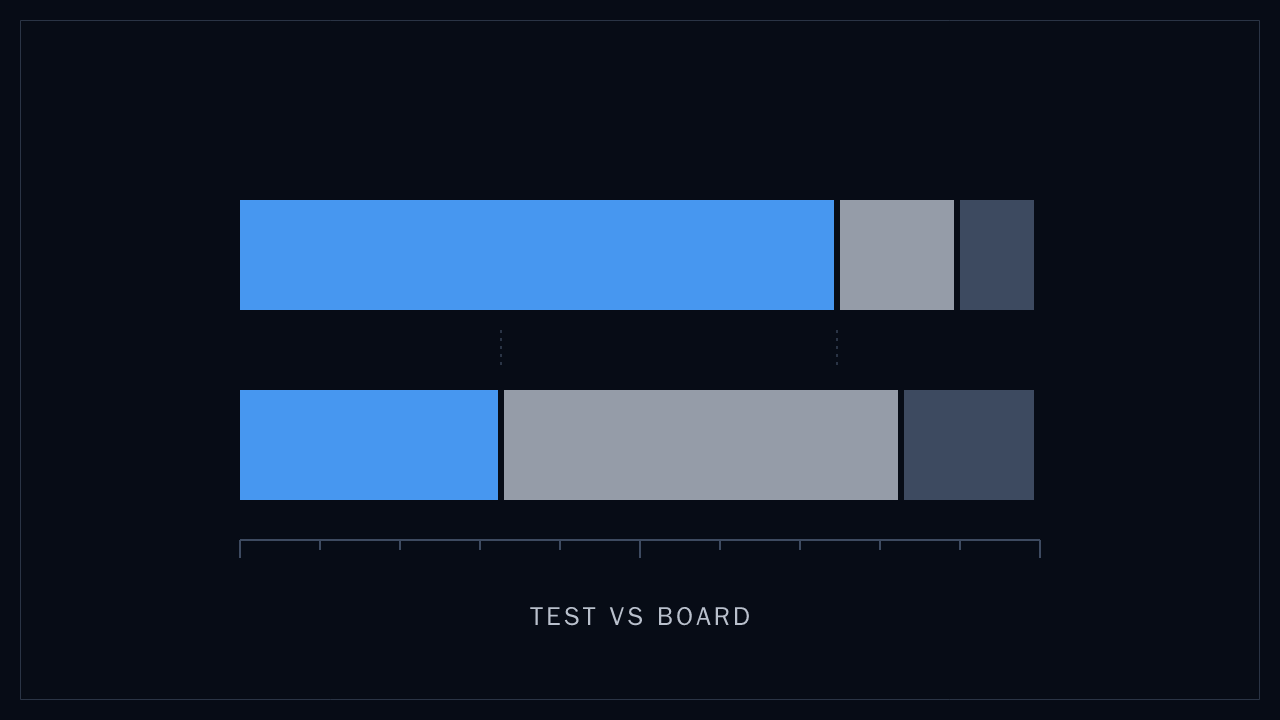
NUST = NET% x 0.75  + HSSC% x 0.15       + SSC% x 0.10
UET  = ECAT% x 0.33 + FSc Part-I% x 0.50 + matric% x 0.17
UET uses your Part-I result even if you have already finished FSc. NUST uses Part-I out of 550 if that is all you have, or the full result out of 1100.
Two applicants show what the weights do:
Applicant A: matric 90%, Part-I 88%, test 55%
  NUST = 41.25 + 13.20 + 9.00  = 63.45
  UET  = 18.15 + 44.00 + 15.30 = 77.45

Applicant B: matric 75%, Part-I 72%, test 75%
  NUST = 56.25 + 10.80 + 7.50  = 74.55
  UET  = 24.75 + 36.00 + 12.75 = 73.50
At NUST, B leads A by about 11 points. At UET, A leads B by about 4. Each university ranks you only against its own applicants, so don't compare a NUST total with a UET total. Compare where you stand within each.
The weights also tell you where an extra hour of study pays off. At NUST, raising your test score by 10 percentage points adds 7.5 aggregate points. At UET the same jump adds 3.3. If you are still in first year, your Part-I exam is worth half your UET aggregate. Treat it that way.
Try your own numbers in the aggregate calculator. The merit formula post covers NUST's side in detail.
Check domicile and seat categories
UET Lahore fills its open merit seats with Punjab-domiciled applicants, ICT included, unless a programme says otherwise. UET's FAQ lists programmes offered on an all-Pakistan basis: Geological Engineering, Metallurgical and Materials Engineering, Mining Engineering, Textile Engineering, Biomedical Engineering, City and Regional Planning, and Product and Industrial Design. If your domicile is outside Punjab and ICT, check the category list before you pay.
UET needs at least 60% in Intermediate for engineering and architecture, and 50% for science, technology and business programmes. Your merit aggregate must also be at least 50%. Your ECAT subject combination must match your Intermediate subjects, because UET considers you only for disciplines that fit that combination. DAE holders are the exception.
NUST has no domicile condition on its NET merit. It needs 60% in SSC and in HSSC. It also offers limited ACT/SAT seats, covered in the ACT/SAT post.
Your next step
Read NET versus ECAT for the test details and use the aggregate calculator for NUST. Keep a separate record of your UET category and calculation.
Use chapter practice for gaps in the shared subjects, then the multi-test plan to organise the remaining work.
Sources and scope
- NUST merit: NET 75%, HSSC 15%, SSC 10%
- UET merit for ECAT programmes: ECAT 33%, FSc Part-I 50%, matric 17%
Source: NUST merit criteria and salient features pages; UET Lahore Fall 2026 undergraduate prospectus, admissions FAQ and ecat.uet.edu.pk; checked October 2026