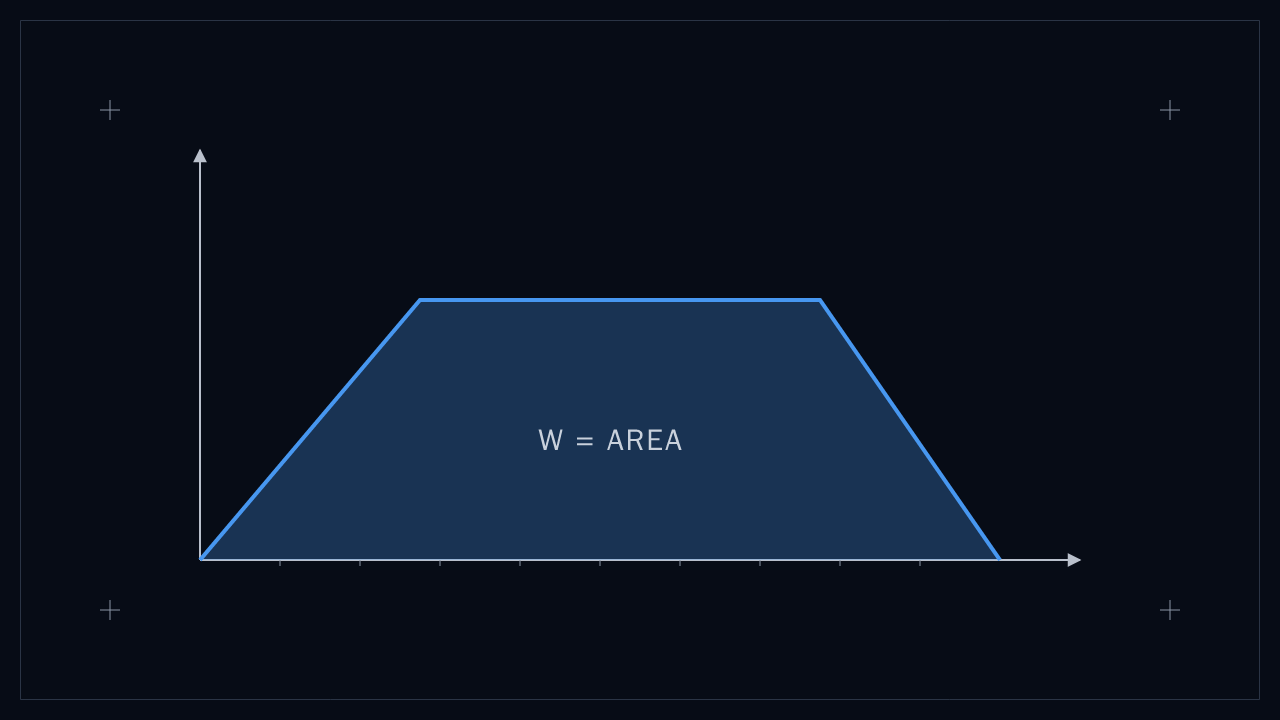
Some motion problems become shorter when you stop trying to find the acceleration. Work and energy let you relate the starting and ending states, provided you account for the forces doing work.
The skill is choosing the method and the system. A formula for kinetic energy will not help if you confuse energy with power, or assume mechanical energy is conserved while friction does work.
Choose the method before calculating
Draw the initial and final states. Decide which energy terms change and whether external or non-conservative work must be included. The sign of work follows the angle between force and displacement.
For power, distinguish an average rate from an instantaneous one. Check units before calculating: energy is measured in joules, while power is measured in watts.
Formula reference
These relationships need the conditions stated in the question. Check units, signs and any restrictions before substituting values.
Work                     W = F·d = Fd cosθ          J = N m
Kinetic energy           K = ½mv² = p² / 2m          J
Potential energy         U = mgh  (near the surface) J
Work-energy theorem      W_net = ΔK = ½mv² − ½mu²
Conservation (no friction)   mgh = ½mv²  so  v = √(2gh)
Work done by friction    W = f × d  (turns into heat)

Power                    P = W / t = Fv cosθ         W = J s⁻¹
Efficiency               η = useful output / input × 100%
1 horsepower             746 W
1 kWh                    3.6 × 10⁶ J

Spring                   W = ½kx²
Absolute PE              U = −GMm / r
Escape velocity          vₑ = √(2GM/R) = √(2gR) ≈ 11.2 km s⁻¹
Orbital speed near Earth v₀ = √(gR) ≈ 7.9 km s⁻¹,  vₑ = √2 v₀
Worked examples
Try each question before reading its solution. These are preparation examples, not official NET questions.
1. Work-energy theorem. A force accelerates a 4 kg object from 3 m/s to 6 m/s in 8 s. How much work does it do?
(a) 27 J (b) 54 J (c) 72 J (d) 96 J
W = ½m(v² − u²) = ½ × 4 × (36 − 9) = 2 × 27 = 54 J
Answer (b). The 8 s is there to tempt you into finding acceleration and distance first. You don't need either. (a) is what you get if you forget the ½m and use v² − u² alone.
2. Power at an angle. A 500 N force acts on an object moving at 10 m/s. The power delivered is 2500 W. What is the angle between the force and the velocity?
(a) 0° (b) 90° (c) 60° (d) 23°
P = Fv cosθ
2500 = 500 × 10 × cosθ
cosθ = 0.5   so  θ = 60°
Answer (c).
3. Motor pulling a cable. A motor exerts 40 N on a cable and pulls it 30 m in one minute. What power does it supply?
(a) 200 W (b) 20 W (c) 10 W (d) 2 W
W = 40 × 30 = 1200 J
P = 1200 / 60 = 20 W
Answer (b). The trap is dividing by 1 instead of 60 and picking a big number. Convert time to seconds before you divide.
4. Machine gun power. A gun fires 360 bullets per minute at 360 km/h. Each bullet has a mass of 20 g. What is the power of the gun?
(a) 75 W (b) 300 W (c) 600 W (d) 1200 W
Bullets per second   360 / 60 = 6
Speed                360 km/h ÷ 3.6 = 100 m/s
KE per bullet        ½ × 0.02 × 100² = 100 J
Power                6 × 100 = 600 W
Answer (c). This one question tests three unit conversions. Slow down on it.
5. Escape velocity with a shrunken Earth. Earth's radius shrinks to a quarter of its value while its mass stays the same. What happens to escape velocity?
(a) doubles (b) halves (c) stays the same (d) quadruples
vₑ = √(2GM/R)
R → R/4   so  vₑ → √4 × vₑ = 2vₑ
Answer (a). Write the version with G and M here. If you use √(2gR), you will think vₑ halves, because you forget that g itself goes up 16 times when R drops to a quarter.
Turn the examples into practice
Try solving a simple motion problem with both Newton's laws and energy. Compare the working and decide why one route was shorter. Use work and energy practice to make that choice independently.
Review force and motion for the force method and keep the physics formula sheet as a revision reference.
Sources and scope
- Use the official subject weightings to check whether this subject belongs to your NET category.
- NUST does not publish a guaranteed chapter question count. These examples are for learning methods, not predicting a paper.
Source: HSSC textbook topics and SailToNUST practice material; NUST subject weightings reviewed October 2026