A force question often goes wrong before any numbers enter the calculation. You may have chosen the wrong object, mixed two sign conventions or treated a force pair as if both acted on one body.
Begin with a sketch and a clear choice of direction. The equations then describe a physical situation rather than becoming formulas you try until one produces an option.
Choose the method before calculating
Isolate the object and draw the forces acting on it. Choose a positive direction, then resolve the forces along that direction. Keep acceleration consistent with the same choice.
For momentum and impulse, define the system and ask whether an external impulse matters. Newton's third-law forces act on different objects; they do not cancel on one object's force diagram.
Formula reference
These relationships need the conditions stated in the question. Check units, signs and any restrictions before substituting values.
Equations of motion (constant acceleration a)
v = u + at
s = ut + ½at²
v² = u² + 2as

Newton's second law     F = ma            N = kg m s⁻²
Momentum                p = mv            kg m s⁻¹ = N s
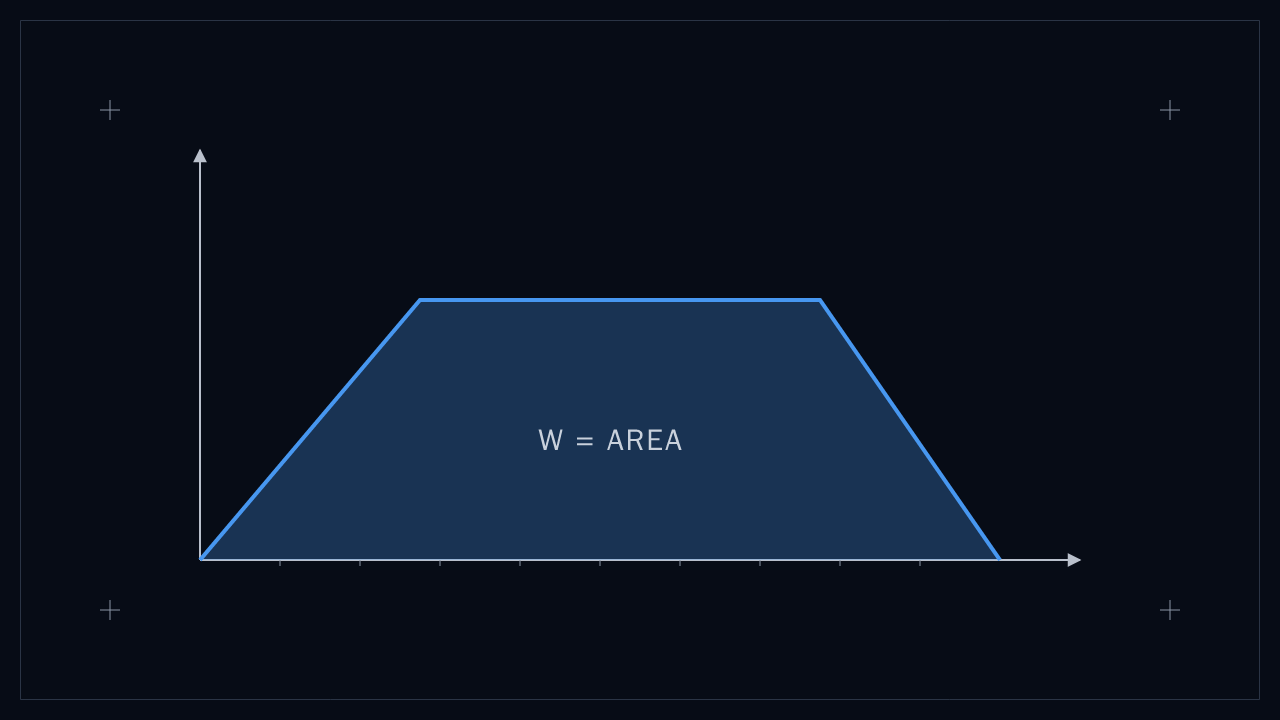
Impulse                 J = FΔt = Δp      N s

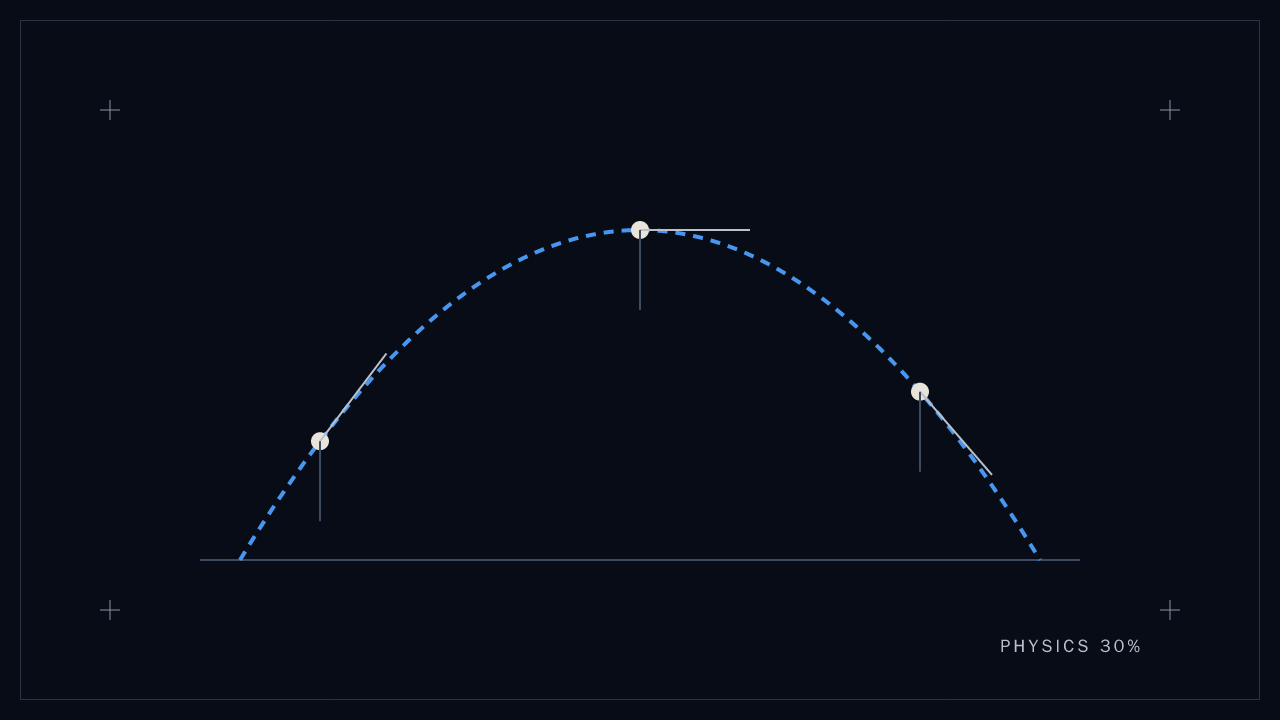
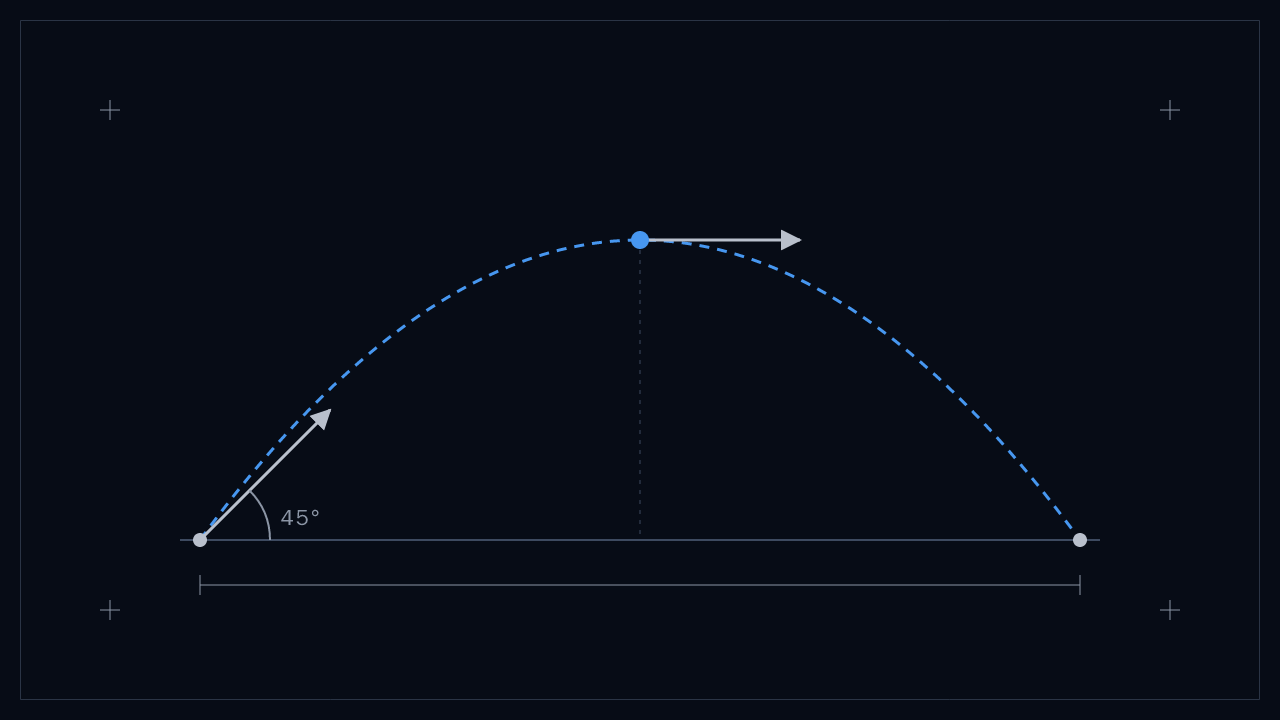
Projectile on level ground (speed u, angle θ above horizontal)
Time of flight          T = 2u sinθ / g
Maximum height          H = u² sin²θ / (2g)
Range                   R = u² sin2θ / g
Maximum range           R_max = u² / g   at θ = 45°

Components of a force F at angle θ to the x-axis
Fx = F cosθ,  Fy = F sinθ,  F = √(Fx² + Fy²)

Equilibrium             ΣF = 0 (first condition)
                        Στ = 0 (second condition)

Apparent weight in a lift (acceleration a)
going up:   R = m(g + a)
going down: R = m(g − a)
Worked examples
Try each question before reading its solution. These are preparation examples, not official NET questions.
1. Projectile range. A ball is thrown at 20 m/s at 30° above the horizontal. Taking g = 10 m/s², how far away does it land?
(a) 20 m (b) 34.6 m (c) 40 m (d) 17.3 m
R = u² sin2θ / g = (400 × sin60°) / 10 = 40 × 0.866 = 34.6 m
Answer (b). Option (c) is u²/g, the maximum range at 45°. You land on it if you drop the sine. A ball thrown at 60° with the same speed lands at the same 34.6 m, because 30° and 60° add up to 90°.
2. Packet dropped from a rising balloon. A balloon rising at 12 m/s releases a packet at a height of 65 m. With g = 10 m/s², how long does the packet take to reach the ground?
(a) 5 s (b) 6 s (c) 7 s (d) 8 s
The packet leaves with the balloon's upward velocity of 12 m/s. Take up as positive. The ground is 65 m below.
−65 = 12t − 5t²
5t² − 12t − 65 = 0
t = [12 + √(144 + 1300)] / 10 = (12 + 38) / 10 = 5 s
Answer (a). If you assumed the packet starts from rest you would get √13 s, about 3.6 s, which is not even an option. The question is testing whether you remember that a dropped object keeps the velocity of whatever it was dropped from.
3. Impulse on a rebounding ball. A 0.2 kg ball hits a wall at 10 m/s and bounces straight back at 10 m/s. Contact lasts 0.01 s. What is the average force on the ball?
(a) 0 N (b) 200 N (c) 400 N (d) 20 N
Δp = m(v − u) = 0.2 × (−10 − 10) = −4 N s
F = Δp / Δt = 4 / 0.01 = 400 N
Answer (c). The speed did not change, but the velocity reversed, so the change in momentum is double the initial momentum. Picking (a) or (b) is the usual mistake.
4. Scale reading in a lift. A 60 kg student stands on a scale in a lift that is accelerating downward at 2 m/s². With g = 10 m/s², what does the scale read?
(a) 720 N (b) 600 N (c) 480 N (d) 120 N
R = m(g − a) = 60 × (10 − 2) = 480 N
Answer (c). The scale reads the normal force, not the weight. Downward acceleration reduces it. A lift moving down at constant speed would read 600 N.
5. Resolving a force. A 15 N force acts along the y-axis. Together with a horizontal force, it gives a resultant at 30° to the x-axis. What is the horizontal force?
(a) 20 N (b) 26 N (c) 30 N (d) 21 N
tan30° = Fy / Fx
Fx = 15 / tan30° = 15 / 0.577 = 26 N
Answer (b). Draw the triangle before you choose sin, cos or tan. Most errors here come from putting the 30° at the wrong corner.
Turn the examples into practice
In force and motion practice, record whether each error came from the diagram, the equation or arithmetic. Repairing the diagram often fixes several question types at once.
Connect this chapter to work and energy, where another method may shorten a motion problem. The physics guide helps organise the rest of the subject.
Sources and scope
- Use the official subject weightings to check whether this subject belongs to your NET category.
- NUST does not publish a guaranteed chapter question count. These examples are for learning methods, not predicting a paper.
Source: HSSC textbook topics and SailToNUST practice material; NUST subject weightings reviewed October 2026