The difficult part of an integral is often the first decision, not the calculation. Should you use a standard result, change the variable, split an expression or use integration by parts?
For NET preparation, practise recognising that choice before trying to work faster. This guide connects the usual patterns to worked examples and explains why an integral and a geometric area can have different signs.
Choose the method before calculating
Look for a function paired with its derivative. A logarithm next to 1/x, or a denominator next to its derivative in the numerator, can suggest a substitution. Write the substitution and the differential together so that a missing factor is easier to catch.
For a definite integral, check the limits and any symmetry before doing algebra. Differentiating an answer option can help with an indefinite integral, but it does not directly verify a numerical definite integral. Use the method that reduces the work in that question.
Formula reference
These relationships need the conditions stated in the question. Check units, signs and any restrictions before substituting values.
∫ x^n dx        = x^(n+1)/(n+1) + C,   n ≠ -1
∫ 1/x dx        = ln|x| + C
∫ e^(ax) dx     = e^(ax)/a + C
∫ a^x dx        = a^x / ln a + C

∫ sin ax dx     = -cos(ax)/a + C
∫ cos ax dx     = sin(ax)/a + C
∫ sec^2 x dx    = tan x + C
∫ csc^2 x dx    = -cot x + C
∫ sec x tan x dx = sec x + C
∫ csc x cot x dx = -csc x + C
∫ tan x dx      = ln|sec x| + C

∫ 1/sqrt(a^2 - x^2) dx = sin^-1(x/a) + C
∫ 1/(a^2 + x^2) dx     = (1/a) tan^-1(x/a) + C
Three patterns that turn most "hard" integrals into one line:
∫ f'(x)/f(x) dx          = ln|f(x)| + C
∫ [f(x)]^n f'(x) dx      = [f(x)]^(n+1)/(n+1) + C
∫ e^x [f(x) + f'(x)] dx  = e^x f(x) + C
Integration by parts, and the properties of definite integrals:
∫ u dv = uv - ∫ v du

∫[a,b] f dx = -∫[b,a] f dx
∫[a,b] f dx + ∫[b,c] f dx = ∫[a,c] f dx
∫[-a,a] f dx = 0                 if f is odd
∫[-a,a] f dx = 2 ∫[0,a] f dx     if f is even
∫[0,a] f(x) dx = ∫[0,a] f(a - x) dx
Worked examples
Try each question before reading its solution. These are preparation examples, not official NET questions.
1. Find ∫ dx / (x sin^2(ln x)).
The 1/x next to ln x is the signal. Put u = ln x, so du = dx/x:
∫ du / sin^2 u = ∫ csc^2 u du = -cot u + C = -cot(ln x) + C
2. Find ∫[1,e] (1 + ln x)/(2x) dx.
Same signal. Let u = 1 + ln x, du = dx/x. The limits change: x = 1 gives u = 1, x = e gives u = 2.
(1/2) ∫[1,2] u du = (1/2) [u^2/2] from 1 to 2 = (1/2)(2 - 1/2) = 3/4
3. Given ∫[1,6] g dx = -3 and ∫[6,8] g dx = 10, find ∫[8,1] -3g(x) dx.
No integration needed. Add the pieces, then reverse the limits and pull out the constant:
∫[1,8] g dx = -3 + 10 = 7
∫[8,1] -3g dx = -3 x (-7) = 21
4. Find ∫[0,2] |x - 1| dx.
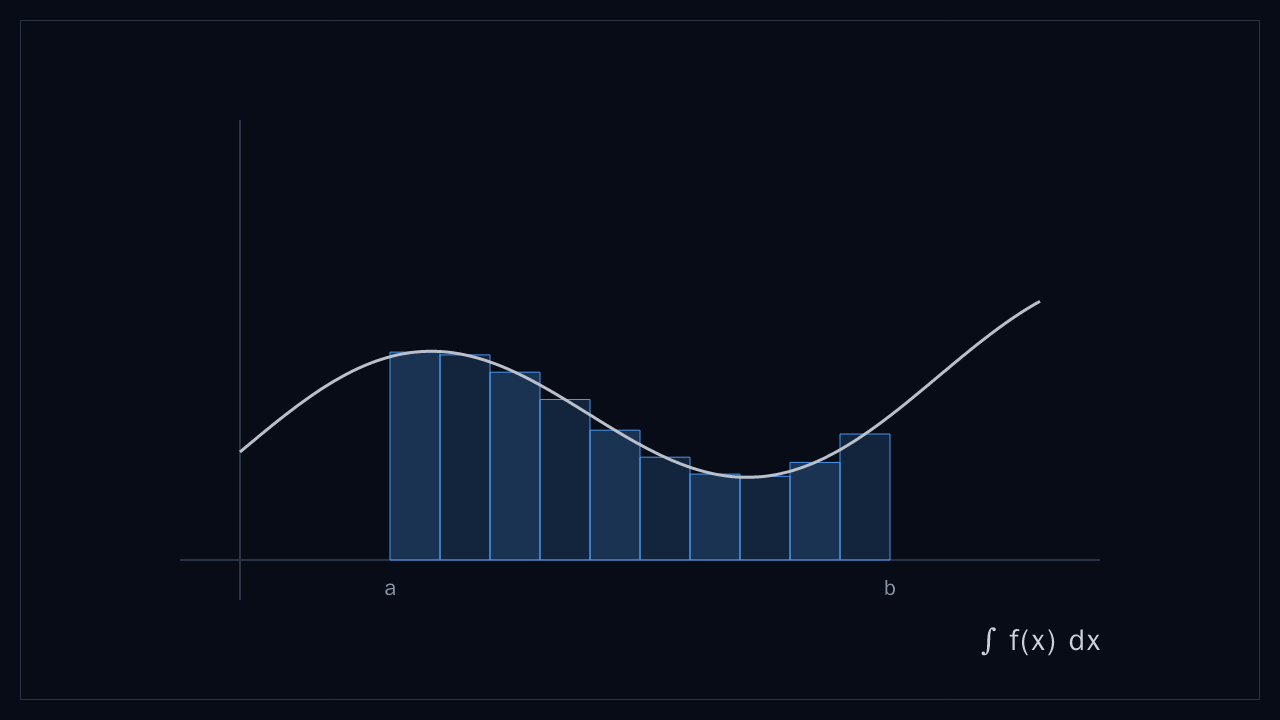
Draw it. The graph is a V touching zero at x = 1. You get two triangles, each with base 1 and height 1, so each has area 1/2. Total: 1.
5. Find ∫ x e^x dx.
By parts, take u = x and dv = e^x dx:
∫ x e^x dx = x e^x - ∫ e^x dx = e^x (x - 1) + C
Check: the derivative of e^x (x - 1) is e^x (x - 1) + e^x = x e^x. Correct.
For area questions the method is the same as example 2. The area under y = x^2 + 1 from x = 1 to x = 4 is [x^3/3 + x] from 1 to 4, which is (64/3 + 4) - (1/3 + 1) = 24.
Turn the examples into practice
Practise substitutions separately at first, then mix them with standard integrals and area questions. If you use a substitution in a definite integral, either change the limits or return to the original variable before evaluation.
Work through integration practice without opening the explanation first. If the derivative check is difficult, revisit differentiation. The formula sheet keeps the standard results together.
Sources and scope
- Use the official subject weightings to check whether this subject belongs to your NET category.
- NUST does not publish a guaranteed chapter question count. These examples are for learning methods, not predicting a paper.
Source: HSSC textbook topics and SailToNUST practice material; NUST subject weightings reviewed October 2026
FAQ
Is integration hard in NET?
f'(x)/f(x) or e^x [f + f'] pattern that turns them into one line.Do I need to write +C in NET?
Should I learn integration by partial fractions for NET?
ln|x| rule.