
A formula sheet is useful when it helps you recover a result you understand. It becomes less useful when you can recognise every line but cannot choose one in a question.
Use this mathematics reference during revision, then close it for practice. Beside any formula you keep forgetting, write what its symbols mean, the conditions for using it and a question where it applies. That turns a list into something you can use under the clock.
Use the sheet to check recall
Choose a chapter and try writing its main results from memory. Compare with the reference, correct the gaps, then solve a few questions without looking. Revisit the same results later rather than rereading the entire sheet every day.
Pay attention to restrictions. A geometric-series sum, an inverse matrix and a logarithm rule each need conditions. Memorising the expression while forgetting those conditions can produce a confident wrong answer.
Do not use the number of formulas in a section as a prediction of NET's chapter distribution. This is a revision reference, not an official formula list supplied for the test.
Algebra
i² = −1    i³ = −i    i⁴ = 1    i^n depends only on n mod 4
z = a + bi    conjugate z̄ = a − bi    |z| = √(a² + b²)
z · z̄ = a² + b² = |z|²        1/z = z̄ / |z|²
Polar form: z = r(cos θ + i sin θ),  r = |z|,  tan θ = b/a (check the quadrant)
|z₁z₂| = |z₁||z₂|        arg(z₁z₂) = arg z₁ + arg z₂
De Moivre: (cos θ + i sin θ)^n = cos nθ + i sin nθ
ax² + bx + c = 0    x = (−b ± √(b² − 4ac)) / 2a
Discriminant D = b² − 4ac
  D > 0  real and distinct      D = 0  real and equal      D < 0  complex conjugates
Sum of roots α + β = −b/a        Product αβ = c/a
Equation with roots α, β:  x² − (α + β)x + αβ = 0
α² + β² = (α + β)² − 2αβ
α³ + β³ = (α + β)³ − 3αβ(α + β)
Roots reciprocal of each other:  c = a
Cube roots of unity: 1, ω, ω²    ω³ = 1    1 + ω + ω² = 0    ω = (−1 + i√3)/2
Remainder theorem: p(x) ÷ (x − a) leaves remainder p(a)
AP:  aₙ = a + (n − 1)d        Sₙ = (n/2)[2a + (n − 1)d] = (n/2)(a + l)
GP:  aₙ = a·r^(n−1)           Sₙ = a(1 − rⁿ)/(1 − r),  r ≠ 1
     S∞ = a/(1 − r),  only when |r| < 1
Means between a and b:  A = (a + b)/2    G = ±√(ab)    H = 2ab/(a + b)
For positive a, b:  A ≥ G ≥ H   and   G² = AH
HP: the reciprocals of the terms form an AP
Σn = n(n + 1)/2    Σn² = n(n + 1)(2n + 1)/6    Σn³ = [n(n + 1)/2]²
ⁿPᵣ = n!/(n − r)!        ⁿCᵣ = n!/[r!(n − r)!]        0! = 1
ⁿCᵣ = ⁿCₙ₋ᵣ              ⁿCᵣ + ⁿCᵣ₋₁ = ⁿ⁺¹Cᵣ
Arrangements with repeats:  n!/(p! q! r!)
Round table:  (n − 1)!       Necklace or garland:  (n − 1)!/2
Diagonals of an n-sided polygon:  ⁿC₂ − n = n(n − 3)/2
Probability:  P(E) = n(E)/n(S),   0 ≤ P(E) ≤ 1,   P(not E) = 1 − P(E)
P(A ∪ B) = P(A) + P(B) − P(A ∩ B)
Independent events:  P(A ∩ B) = P(A)·P(B)
Induction and binomial theorem
(a + b)ⁿ = Σ ⁿCᵣ a^(n−r) b^r,  r = 0 to n
General term:  Tᵣ₊₁ = ⁿCᵣ a^(n−r) b^r
Number of terms = n + 1        Sum of coefficients = 2ⁿ
Middle term:  n even → T(n/2 + 1)     n odd → T((n+1)/2) and T((n+3)/2)
Any n, |x| < 1:  (1 + x)ⁿ = 1 + nx + n(n − 1)x²/2! + n(n − 1)(n − 2)x³/3! + ...
The trap in binomial questions is the sign. In (x² − 3/(2x))¹⁰ the second term carries (−1)^r, so check whether r is odd before you pick a positive option.
Matrices and vectors
A = [a b; c d]    |A| = ad − bc    A⁻¹ = (1/|A|)·[d −b; −c a]
A⁻¹ = adj(A)/|A|      A is singular when |A| = 0 (no inverse)
(AB)⁻¹ = B⁻¹A⁻¹       (AB)ᵗ = BᵗAᵗ
|AB| = |A||B|    |Aᵗ| = |A|    |A⁻¹| = 1/|A|    |kA| = kⁿ|A| for an n × n matrix
|A| = 0 if two rows (or columns) are equal, or one row is all zeros
Swapping two rows changes the sign of |A|
Cramer's rule:  x = |Aₓ|/|A|,  y = |Aᵧ|/|A|,  z = |A_z|/|A|
v = xi + yj + zk    |v| = √(x² + y² + z²)    unit vector v̂ = v/|v|
a · b = |a||b| cos θ = a₁b₁ + a₂b₂ + a₃b₃
|a × b| = |a||b| sin θ
i·i = j·j = k·k = 1      i·j = j·k = k·i = 0
i × j = k    j × k = i    k × i = j    (reverse order flips the sign)
Perpendicular:  a · b = 0          Parallel:  a × b = 0
Area of parallelogram = |a × b|    Area of triangle = ½|a × b|
Projection of a on b = (a · b)/|b|
Scalar triple product a · (b × c) = determinant of the components
  = volume of the parallelepiped;  zero when a, b, c are coplanar
Direction cosines:  cos²α + cos²β + cos²γ = 1
Trigonometry
π rad = 180°    1° = π/180 ≈ 0.01745 rad    1 rad ≈ 57.3°
Arc length l = rθ        Sector area = ½r²θ        (θ in radians)

sin²θ + cos²θ = 1    1 + tan²θ = sec²θ    1 + cot²θ = cosec²θ

sin(A ± B) = sin A cos B ± cos A sin B
cos(A ± B) = cos A cos B ∓ sin A sin B
tan(A ± B) = (tan A ± tan B)/(1 ∓ tan A tan B)

sin 2A = 2 sin A cos A
cos 2A = cos²A − sin²A = 2cos²A − 1 = 1 − 2sin²A
tan 2A = 2 tan A/(1 − tan²A)
sin²A = (1 − cos 2A)/2        cos²A = (1 + cos 2A)/2
sin 3A = 3 sin A − 4 sin³A    cos 3A = 4 cos³A − 3 cos A

sin C + sin D = 2 sin((C+D)/2) cos((C−D)/2)
sin C − sin D = 2 cos((C+D)/2) sin((C−D)/2)
cos C + cos D = 2 cos((C+D)/2) cos((C−D)/2)
cos C − cos D = −2 sin((C+D)/2) sin((C−D)/2)

Periods: sin x, cos x → 2π    tan x, cot x → π    sin(ax) → 2π/a
Range of a sin x + b cos x:  from −√(a² + b²) to +√(a² + b²)
Signs: all positive in Q1, sin in Q2, tan in Q3, cos in Q4
Triangles
Sine rule:    a/sin A = b/sin B = c/sin C = 2R
Cosine rule:  a² = b² + c² − 2bc cos A
Area = ½ab sin C        Hero:  Δ = √(s(s − a)(s − b)(s − c)),  s = (a + b + c)/2
Circumradius R = abc/(4Δ)        Inradius r = Δ/s
Functions, limits and differentiation
x → 0:   sin x / x → 1  (x in radians)      (aˣ − 1)/x → ln a      (1 + x)^(1/x) → e
n → ∞:   (1 + 1/n)ⁿ → e
x → a:   (xⁿ − aⁿ)/(x − a) → n·a^(n−1)
Rational function as x → ∞:
  top degree lower → 0     equal → ratio of leading coefficients     higher → ±∞
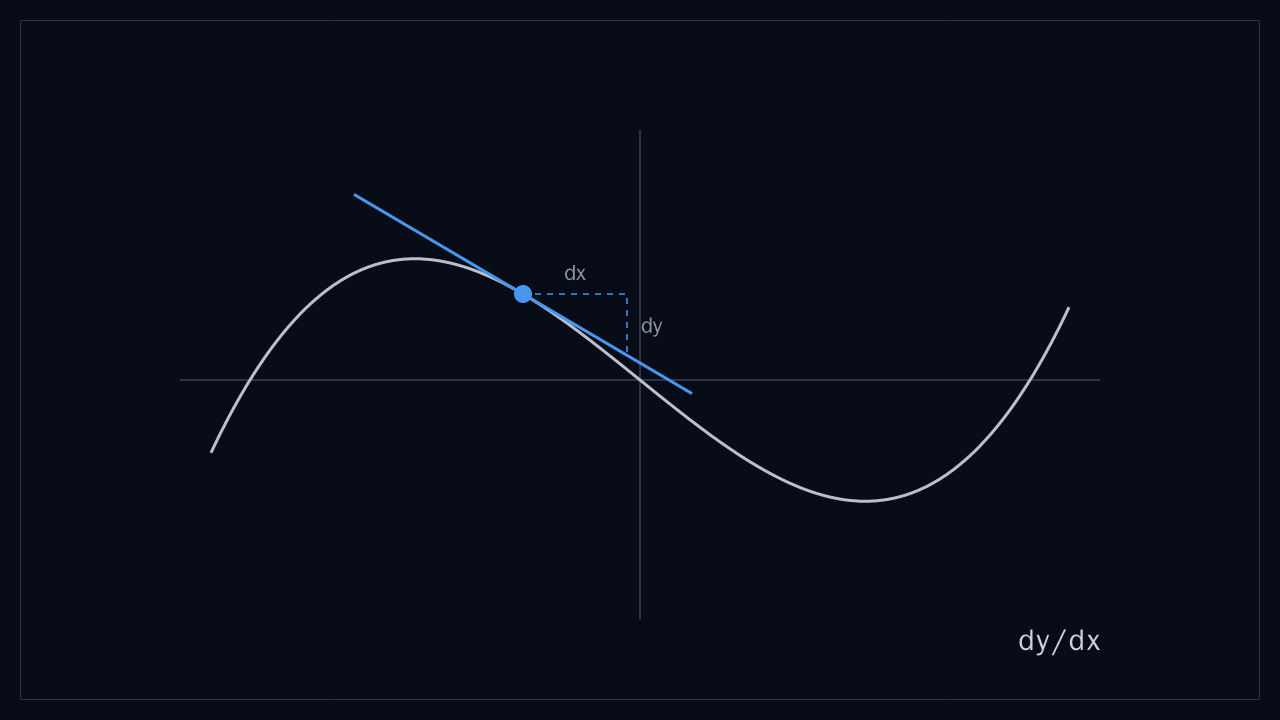
f'(x) = lim (h → 0) [f(x + h) − f(x)]/h
d/dx xⁿ = n·x^(n−1)
d/dx sin x = cos x          d/dx cos x = −sin x
d/dx tan x = sec²x          d/dx cot x = −cosec²x
d/dx sec x = sec x tan x    d/dx cosec x = −cosec x cot x
d/dx eˣ = eˣ    d/dx aˣ = aˣ ln a    d/dx ln x = 1/x    d/dx logₐx = 1/(x ln a)
d/dx sin⁻¹x = 1/√(1 − x²)    d/dx cos⁻¹x = −1/√(1 − x²)    d/dx tan⁻¹x = 1/(1 + x²)
Product: (uv)' = u'v + uv'        Quotient: (u/v)' = (u'v − uv')/v²
Chain: dy/dx = (dy/du)(du/dx)     Degree sign: d/dx sin x° = (π/180) cos x°
nth derivative:  eᵃˣ → aⁿeᵃˣ      sin(ax) → aⁿ sin(ax + nπ/2)      cos(ax) → aⁿ cos(ax + nπ/2)
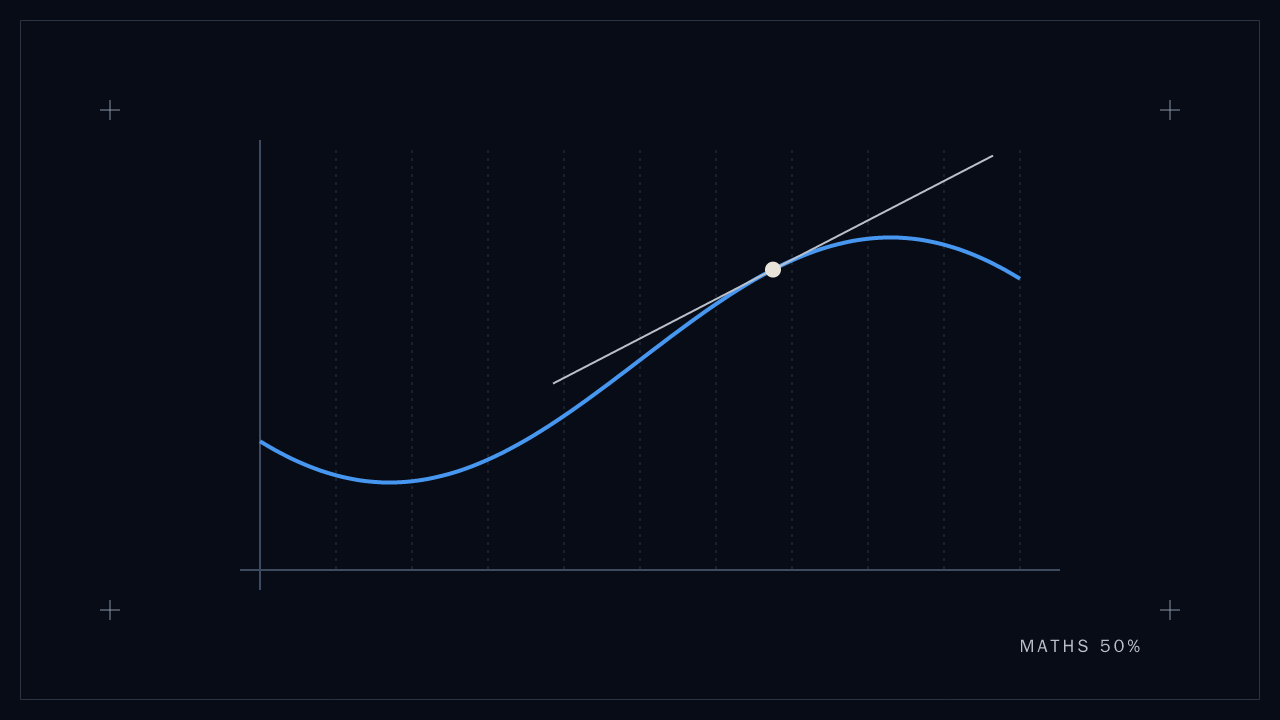
Tangent at (x₁, y₁):  y − y₁ = m(x − x₁),  m = f'(x₁)       Normal slope = −1/m
Stationary point f'(x) = 0:   f''(x) < 0 → maximum     f''(x) > 0 → minimum
Integration
∫ xⁿ dx = x^(n+1)/(n + 1) + C,  n ≠ −1        ∫ (1/x) dx = ln|x| + C
∫ eᵃˣ dx = eᵃˣ/a + C                          ∫ aˣ dx = aˣ/ln a + C
∫ sin x dx = −cos x + C                       ∫ cos x dx = sin x + C
∫ sec²x dx = tan x + C                        ∫ cosec²x dx = −cot x + C
∫ sec x tan x dx = sec x + C                  ∫ cosec x cot x dx = −cosec x + C
∫ tan x dx = ln|sec x| + C                    ∫ cot x dx = ln|sin x| + C
∫ sec x dx = ln|sec x + tan x| + C            ∫ cosec x dx = ln|cosec x − cot x| + C
∫ dx/(a² + x²) = (1/a) tan⁻¹(x/a) + C
∫ dx/√(a² − x²) = sin⁻¹(x/a) + C
∫ dx/(x² − a²) = (1/2a) ln|(x − a)/(x + a)| + C
∫ f'(x)/f(x) dx = ln|f(x)| + C
∫ [f(x)]ⁿ f'(x) dx = [f(x)]^(n+1)/(n + 1) + C
∫ eˣ[f(x) + f'(x)] dx = eˣ f(x) + C
By parts: ∫ u dv = uv − ∫ v du

Definite integrals:
Notation: ∫[a→b] means the integral from x = a to x = b
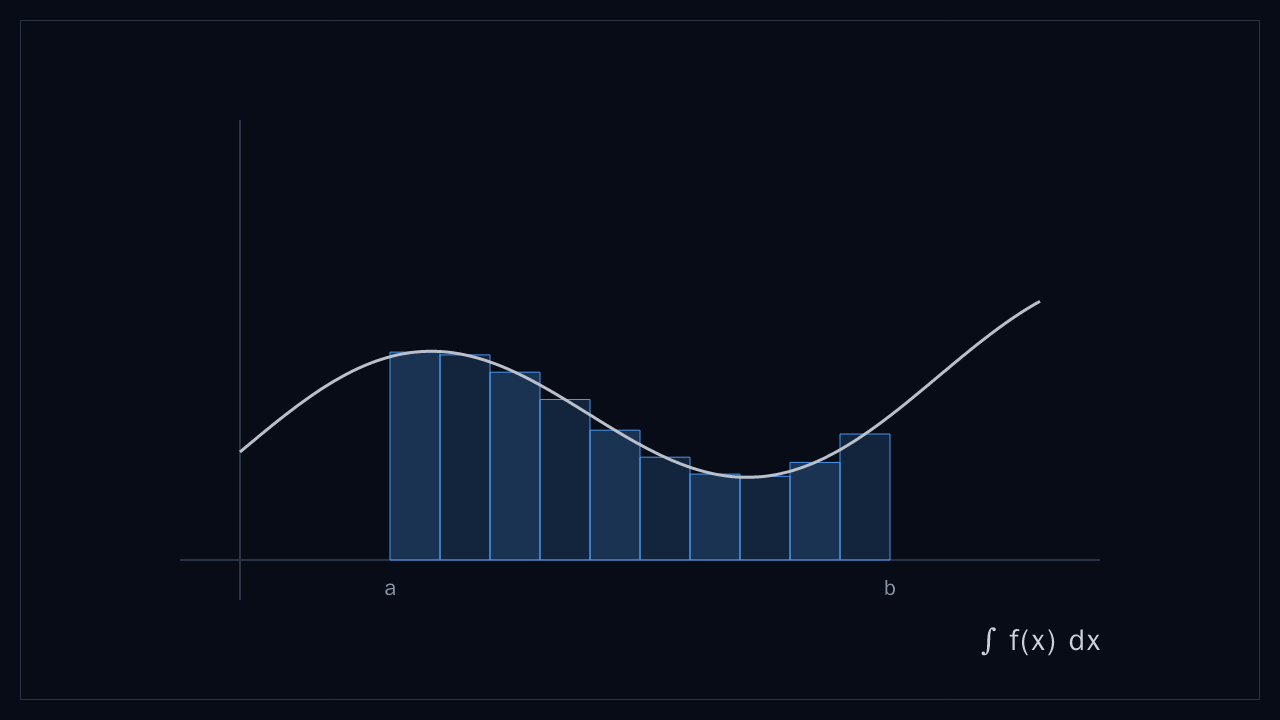
∫[a→b] f(x) dx = F(b) − F(a)     ∫[a→b] f = −∫[b→a] f     ∫[a→a] f = 0
∫[−a→a] f = 0 if f is odd        ∫[−a→a] f = 2∫[0→a] f if f is even
∫[0→a] f(x) dx = ∫[0→a] f(a − x) dx
Area between curves = ∫ (upper − lower) dx
The eˣ[f(x) + f'(x)] rule looks obscure, but it answers a whole family of MCQs in one line. ∫eˣ(tan⁻¹x + 1/(1 + x²)) dx is eˣ tan⁻¹x + C, because the second bracket term is the derivative of the first.
Coordinate geometry and conics
Distance = √((x₂ − x₁)² + (y₂ − y₁)²)
Point dividing in ratio m:n (internal) = ((mx₂ + nx₁)/(m + n), (my₂ + ny₁)/(m + n))
Centroid = ((x₁ + x₂ + x₃)/3, (y₁ + y₂ + y₃)/3)
Slope m = (y₂ − y₁)/(x₂ − x₁) = tan θ
Parallel: m₁ = m₂        Perpendicular: m₁m₂ = −1
Lines:  y = mx + c    y − y₁ = m(x − x₁)    x/a + y/b = 1    x cos α + y sin α = p
Point to line ax + by + c = 0:  d = |ax₁ + by₁ + c| / √(a² + b²)
Angle between lines: tan θ = |(m₂ − m₁)/(1 + m₁m₂)|
Triangle area = ½|x₁(y₂ − y₃) + x₂(y₃ − y₁) + x₃(y₁ − y₂)|
Pair of lines ax² + 2hxy + by² = 0:  m₁ + m₂ = −2h/b,  m₁m₂ = a/b
  perpendicular when a + b = 0
Circle:  (x − h)² + (y − k)² = r²
  x² + y² + 2gx + 2fy + c = 0  →  centre (−g, −f),  r = √(g² + f² − c)
  Tangent to x² + y² = a² at (x₁, y₁):  xx₁ + yy₁ = a²
  y = mx + c touches x² + y² = a²  when  c² = a²(1 + m²)

Parabola y² = 4ax:  vertex (0, 0),  focus (a, 0),  directrix x = −a,  latus rectum 4a
  Tangent at (x₁, y₁):  yy₁ = 2a(x + x₁)        y = mx + c is a tangent when c = a/m

Ellipse x²/a² + y²/b² = 1,  a > b:
  c² = a² − b²,  e = c/a  (0 < e < 1),  foci (±c, 0),  directrices x = ±a/e,  latus rectum 2b²/a

Hyperbola x²/a² − y²/b² = 1:
  c² = a² + b²,  e = c/a  (e > 1),  foci (±c, 0),  asymptotes y = ±(b/a)x,  latus rectum 2b²/a

Eccentricity:  circle 0    ellipse between 0 and 1    parabola 1    hyperbola above 1
Rectangular hyperbola (a = b):  e = √2
Your next step
Use Mathematics practice to test recall. If you cannot explain a result, return to the corresponding chapter guide before repeating the question.
The differentiation and integration guides show how closely related results need different checks.
Sources and scope
- Mathematics is 50% of NET-Engineering and NET-Natural Sciences and 30% of NET-Architecture
- The syllabus follows the HSSC Part-I and Part-II mathematics books
Source: NUST, Subjects included in NET with weightings, checked October 2026