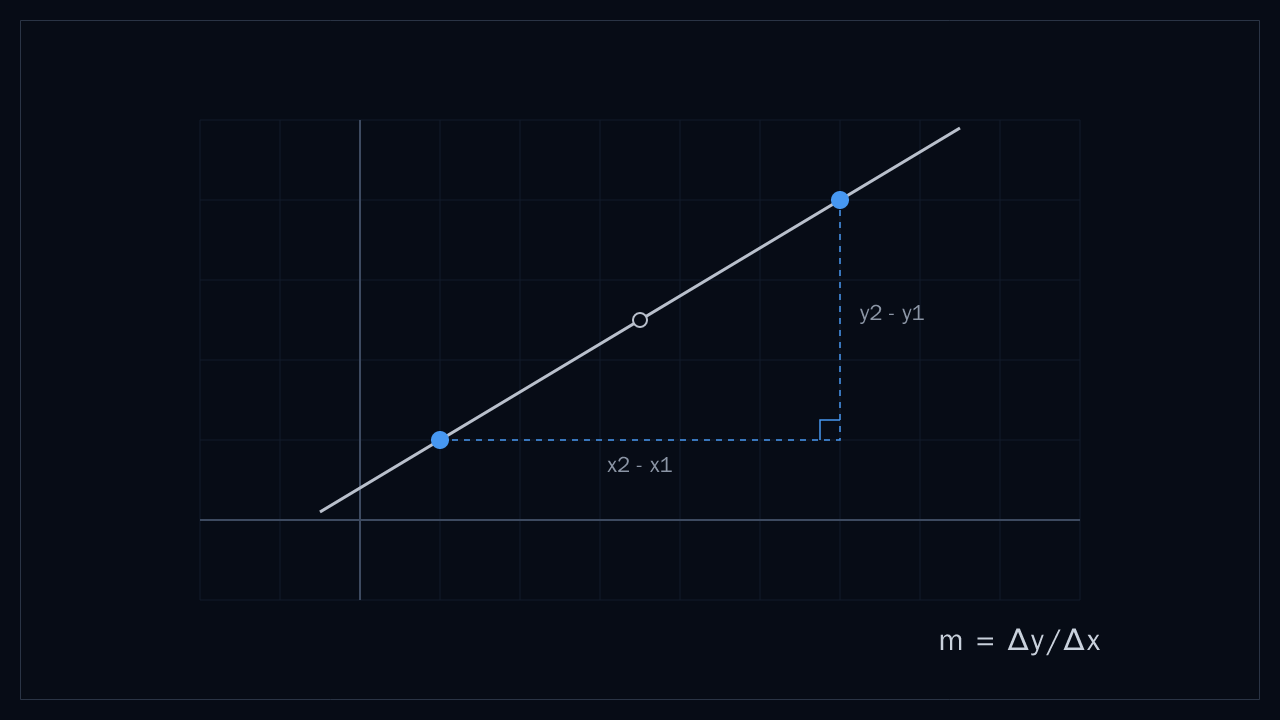
A conic equation becomes easier to read when you put it into standard form. The centre, orientation and lengths then tell you what the curve is doing before you calculate a focus or tangent.
The main preparation task is to keep the curves distinct. A sign change that looks small in algebra can turn an ellipse into a hyperbola, while the direction of a parabola depends on which variable is squared.
Choose the method before calculating
Complete the square carefully and divide the whole equation into standard form. Then label the centre or vertex, the axis and the parameters. Do not assume that the x term always determines the larger axis.
Use a rough sketch to check whether a focus or directrix is on the expected side. Remember that the relationship between a, b and c differs between ellipses and hyperbolas.
Formula reference
These relationships need the conditions stated in the question. Check units, signs and any restrictions before substituting values.
Circle:
(x - h)^2 + (y - k)^2 = r^2
x^2 + y^2 + 2gx + 2fy + c = 0
    centre (-g, -f),  r = sqrt(g^2 + f^2 - c)
    r^2 = 0  point circle,   r^2 negative  imaginary circle
tangent to x^2 + y^2 = a^2 at (x1, y1):   x x1 + y y1 = a^2
y = mx + c touches x^2 + y^2 = a^2  if  c^2 = a^2 (1 + m^2)
Parabola y^2 = 4ax:
focus (a, 0),  directrix x = -a,  latus rectum 4a,  e = 1
tangent at (x1, y1):         y y1 = 2a(x + x1)
y = mx + c is a tangent if   c = a/m
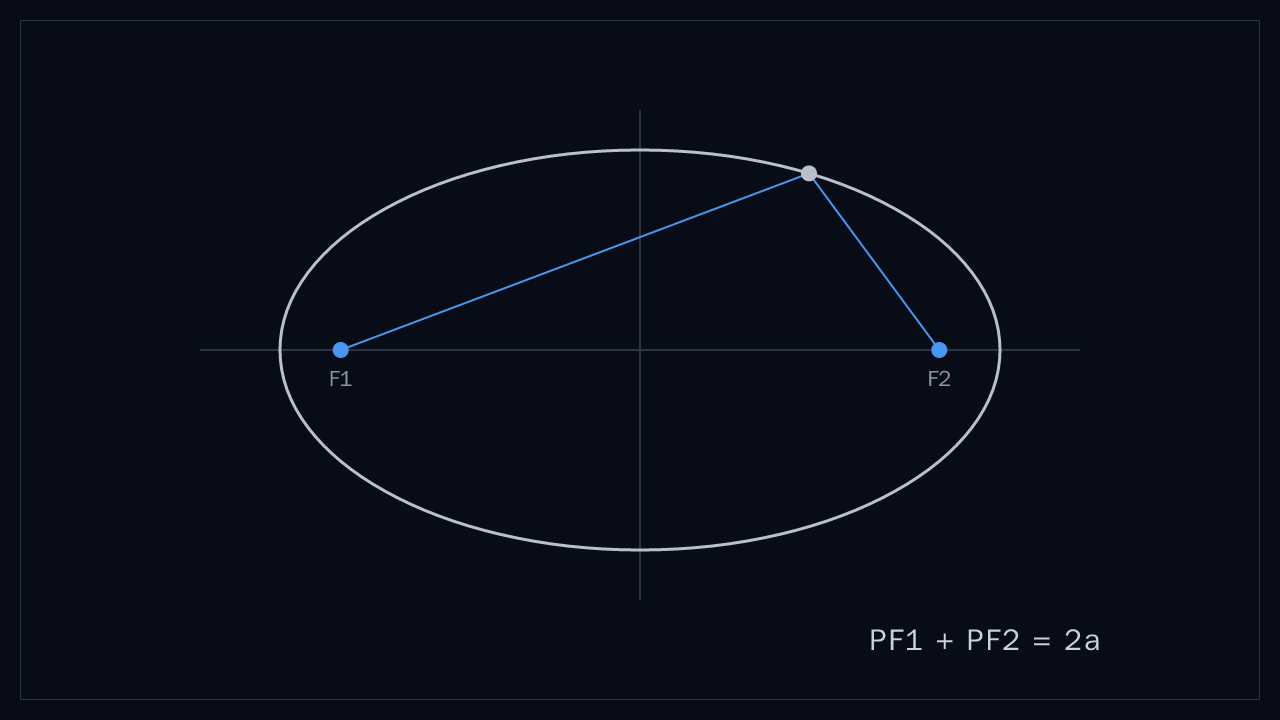
Ellipse x^2/a^2 + y^2/b^2 = 1 with a greater than b:
c^2 = a^2 - b^2,   e = c/a  (less than 1)
foci (±c, 0),  vertices (±a, 0)
sum of distances to the foci = 2a
latus rectum = 2b^2/a
y = mx + c is a tangent if   c^2 = a^2 m^2 + b^2
Hyperbola x^2/a^2 - y^2/b^2 = 1:
c^2 = a^2 + b^2,   e = c/a  (greater than 1)
foci (±c, 0)
difference of distances to the foci = 2a
asymptotes y = ±(b/a) x
y = mx + c is a tangent if   c^2 = a^2 m^2 - b^2
Eccentricity sorts the family: e = 0 for a circle, e less than 1 for an ellipse, e = 1 for a parabola, e greater than 1 for a hyperbola.
Worked examples
Try each question before reading its solution. These are preparation examples, not official NET questions.
1. Find the eccentricity of x^2/4 - y^2/9 = 1.
It is a hyperbola, so add: c^2 = 4 + 9 = 13. Then e = c/a = sqrt(13)/2.
2. Find the centre of 2x^2 + 2y^2 + 2x - 4y + 7 = 0.
Divide by 2 first. The circle form needs the x^2 coefficient to be 1:
x^2 + y^2 + x - 2y + 7/2 = 0
g = 1/2,  f = -1    centre (-1/2, 1)
r^2 = 1/4 + 1 - 7/2 = -9/4
The centre is (-1/2, 1). Note the radius squared is negative, so this is an imaginary circle. If a question asks about its radius, that is the point.
3. If y = 4x + c touches x^2/8 + y^2/4 = 1, find c.
c^2 = a^2 m^2 + b^2 = 8(16) + 4 = 132
c = ±sqrt(132)
4. Find the tangent to y^2 = 6x at the point where y = 6.
On the curve, y = 6 gives x = 6. Here 4a = 6, so a = 3/2:
y(6) = 2(3/2)(x + 6)
6y = 3x + 18
x - 2y + 6 = 0
5. Find the distance between the foci of 9x^2 - 18x + 4y^2 + 8y - 23 = 0.
Complete the square in x and y:
9(x - 1)^2 - 9 + 4(y + 1)^2 - 4 - 23 = 0
9(x - 1)^2 + 4(y + 1)^2 = 36
(x - 1)^2/4 + (y + 1)^2/9 = 1
The larger denominator is under y, so the major axis is vertical, with a^2 = 9 and b^2 = 4. Then c^2 = 5, and the foci are 2c = 2 sqrt(5) apart.
Turn the examples into practice
Practise identifying curves before attempting longer calculations. Once identification is reliable, mix questions on centres, foci, eccentricity and tangents. Keep the defining relationships beside one example of each curve.
Use conic practice, revisit coordinate geometry for line work, and check the formula sheet during revision.
Sources and scope
- Use the official subject weightings to check whether this subject belongs to your NET category.
- NUST does not publish a guaranteed chapter question count. These examples are for learning methods, not predicting a paper.
Source: HSSC textbook topics and SailToNUST practice material; NUST subject weightings reviewed October 2026
FAQ
Which conic sections topics are most important for NET?
How do I identify a conic from its general equation?
x^2 and y^2 coefficients give a circle, only one squared term gives a parabola, same signs give an ellipse, and opposite signs give a hyperbola.