A wave carries a disturbance through space, while the particles of the medium may only oscillate around their positions. Confusing those motions makes wave-speed and vibration questions harder than they need to be.
Start by distinguishing the quantities in the question: frequency, period, wavelength, amplitude and phase. Then decide whether you are describing a travelling wave, a standing wave or a single oscillator.
Choose the method before calculating
Keep the source and medium separate. When a wave crosses into another medium, the frequency set by the source stays the same while speed and wavelength may change.
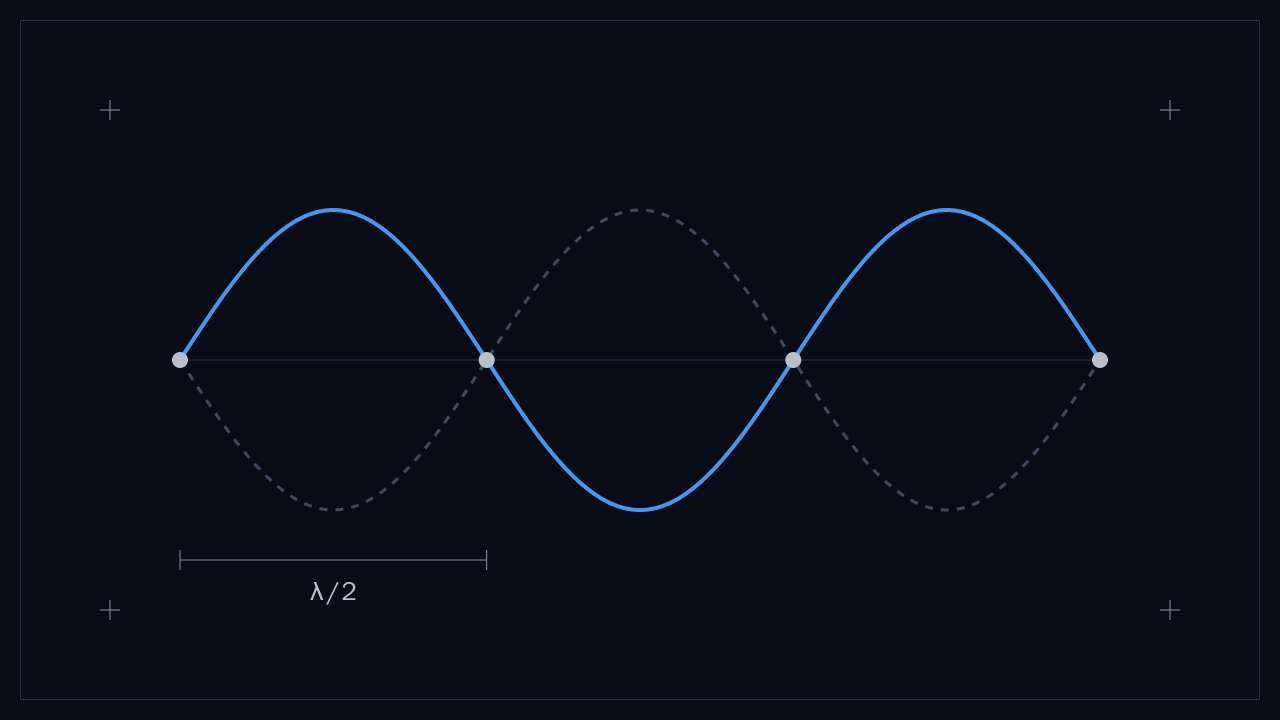
For standing waves, sketch the end conditions before choosing a harmonic formula. A string fixed at both ends and a pipe closed at one end do not have the same allowed modes.
Formula reference
These relationships need the conditions stated in the question. Check units, signs and any restrictions before substituting values.
SHM condition         a = −ω²x
Displacement          x = x₀ sin(ωt + φ)
Speed                 v = ω√(x₀² − x²);   v_max = ωx₀  (at x = 0)
Acceleration          a_max = ω²x₀        (at x = ±x₀)
ω = 2πf = 2π/T                            rad s⁻¹

Spring-block          T = 2π√(m/k)
Simple pendulum       T = 2π√(l/g)
Energy                E = ½kx₀² (constant);  KE = ½k(x₀² − x²)

Wave speed            v = fλ
Wave on a string      v = √(T/μ)   (μ = mass per metre, kg m⁻¹)
Speed of sound        v ∝ √T (kelvin);  about 332 m/s at 0 °C

Standing waves (length L)
String fixed both ends   fₙ = nv / 2L        n = 1, 2, 3 ...
Pipe open both ends      fₙ = nv / 2L        n = 1, 2, 3 ...
Pipe closed one end      fₙ = nv / 4L        n = 1, 3, 5 ... (odd only)
Node to node             λ/2

Beats                 f_beat = |f₁ − f₂|

Doppler (sound speed v)
Source moving toward still observer at uₛ    f' = f v / (v − uₛ)
Observer moving toward still source at uₒ    f' = f (v + uₒ) / v
(flip the signs for motion away)
Worked examples
Try each question before reading its solution. These are preparation examples, not official NET questions.
1. Doppler ratio. A sound source moves toward a stationary observer at one tenth of the speed of sound. What is the ratio of heard frequency to emitted frequency?
(a) 10/9 (b) 11/10 (c) (11/10)² (d) (9/10)²
f'/f = v / (v − v/10) = 1 / (9/10) = 10/9
Answer (a). If the observer moved toward a still source at v/10 instead, the ratio would be 11/10. Source and observer motion are not interchangeable.
2. Lengthening a pendulum. A pendulum has a period of 2.0 s. Its length is increased by 21%. What is the new period?
(a) 2.1 s (b) 2.2 s (c) 2.42 s (d) 2.0 s
T ∝ √l
T' = 2.0 × √1.21 = 2.0 × 1.1 = 2.2 s
Answer (b). Setters like 21% and 44% because 1.21 and 1.44 have clean square roots. Option (c) is what you get if you forget the square root.
3. Closed pipe. A pipe 0.5 m long is closed at one end. The speed of sound is 340 m/s. What is its fundamental frequency, and what is the next frequency it can produce?
f₁ = v / 4L = 340 / 2 = 170 Hz
next: 3f₁ = 510 Hz  (closed pipes skip even harmonics)
Open the closed end and the fundamental becomes v/2L = 340 Hz. That is the one-liner that shows up as "f_open = 2 f_closed" for pipes of equal length.
4. Beats and wax. Tuning fork A has frequency 256 Hz. It makes 4 beats per second with fork B. Loading B with wax reduces the beat frequency. What was B's frequency?
(a) 252 Hz (b) 254 Hz (c) 258 Hz (d) 260 Hz
B is 256 ± 4: either 252 Hz or 260 Hz
Wax lowers B's frequency
If B = 260, lowering it moves it closer to 256  →  fewer beats (matches)
If B = 252, lowering it moves it further away   →  more beats
B = 260 Hz
Answer (d). Filing a prong does the opposite: it raises the frequency.
5. Speed in SHM. A body moves in SHM with amplitude 0.1 m and period 0.2π s. What are its maximum speed and maximum acceleration?
ω = 2π / T = 2π / 0.2π = 10 rad/s
v_max = ωx₀ = 10 × 0.1 = 1 m/s
a_max = ω²x₀ = 100 × 0.1 = 10 m/s²
Speed is maximum at the centre, where acceleration is zero. Acceleration is maximum at the ends, where speed is zero.
Turn the examples into practice
Alternate sketches with calculations. Label nodes and antinodes, convert period to frequency carefully, and check whether the question asks for a particle speed or a wave speed.
Try waves practice, continue to physical optics, and use the formula sheet to compare the related results.
Sources and scope
- Use the official subject weightings to check whether this subject belongs to your NET category.
- NUST does not publish a guaranteed chapter question count. These examples are for learning methods, not predicting a paper.
Source: HSSC textbook topics and SailToNUST practice material; NUST subject weightings reviewed October 2026