A nuclear equation can often be checked before you know the name of the emitted particle. Charge and nucleon number must balance. That gives you a way to reason through the question rather than memorise each reaction separately.
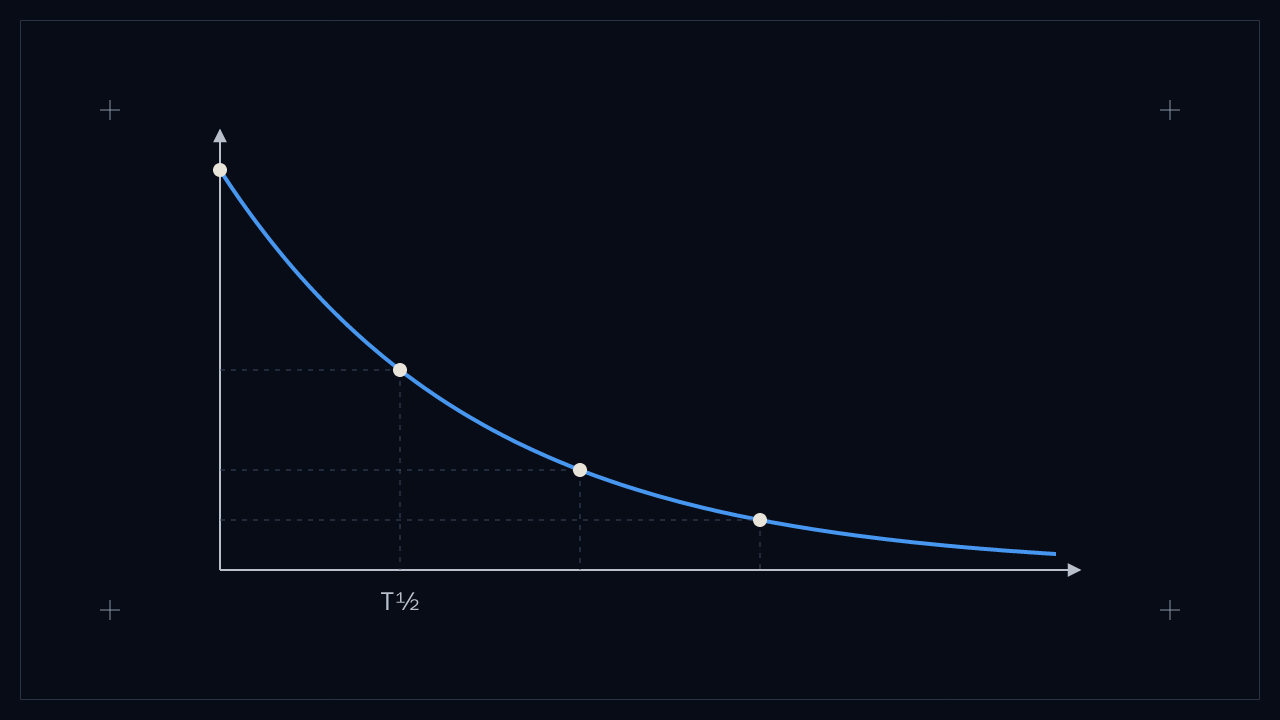
Radioactive decay needs a different habit: track what remains after each half-life, and distinguish the number of undecayed nuclei from the number that have decayed.
Choose the method before calculating
Balance mass number and atomic number in every reaction. For binding energy, keep the mass convention consistent and account for whether the listed values are atomic or nuclear masses.
For a decay calculation, write the fraction remaining first. After several half-lives it is a repeated factor of one half, rather than a fixed amount subtracted each time. Activity is a decay rate, not the remaining mass itself.
Formula reference
These relationships need the conditions stated in the question. Check units, signs and any restrictions before substituting values.
Alpha decay      X(A, Z) → Y(A − 4, Z − 2) + He-4
Beta-minus       X(A, Z) → Y(A, Z + 1) + electron + antineutrino
Gamma            no change in A or Z

Half-life        N = N₀ (½)^(t / T½)
Decay constant   λ = 0.693 / T½              s⁻¹
Activity         A = λN                      becquerel, Bq = s⁻¹

Mass defect      Δm = Z mₚ + (A − Z) mₙ − M_nucleus
Binding energy   E = Δm c²
                 1 u = 931.5 MeV
Binding energy per nucleon peaks near iron-56, at about 8.8 MeV

Nuclear radius   R = R₀ A^(1/3),  R₀ ≈ 1.2 × 10⁻¹⁵ m
Sizes            atom about 10⁻¹⁰ m, nucleus about 10⁻¹⁵ to 10⁻¹⁴ m
Worked examples
Try each question before reading its solution. These are preparation examples, not official NET questions.
1. Half-life from a fraction. The activity of a sample falls to 1/64 of its first value in 30 s. What is the half-life?
(a) 2 s (b) 4 s (c) 5 s (d) 6 s
1/64 = (½)⁶  so  6 half-lives in 30 s
T½ = 30 / 6 = 5 s
Answer (c). Know the powers of 2 up to 1024 and these become one-step questions.
2. Mass remaining. A sample has 80 g of an isotope with a half-life of 2 days. How much remains after 8 days?
(a) 20 g (b) 10 g (c) 5 g (d) 0 g
8 days / 2 days = 4 half-lives
80 → 40 → 20 → 10 → 5 g
Answer (c). The other 75 g has not vanished. It has turned into a daughter nucleus.
3. Counting decays in a series. Uranium-238 (Z = 92) decays in a series to lead-206 (Z = 82). How many alpha and beta-minus decays take place?
(a) 8 alpha, 6 beta (b) 6 alpha, 8 beta (c) 8 alpha, 8 beta (d) 10 alpha, 2 beta
Only alpha changes A:  (238 − 206) / 4 = 8 alpha
8 alpha drop Z by 16:  92 − 16 = 76
Lead has Z = 82, so Z must rise by 6:  6 beta-minus
Answer (a). Always count alphas from the mass number first. Betas then fix the leftover charge.
4. Binding energy of helium-4. A helium-4 nucleus has mass 4.001506 u. Take mₚ = 1.007276 u and mₙ = 1.008665 u. What is its binding energy per nucleon?
(a) 28.3 MeV (b) 7.07 MeV (c) 0.030 MeV (d) 931.5 MeV
Mass of parts   2(1.007276) + 2(1.008665) = 4.031882 u
Mass defect     4.031882 − 4.001506 = 0.030376 u
Binding energy  0.030376 × 931.5 ≈ 28.3 MeV
Per nucleon     28.3 / 4 ≈ 7.07 MeV
Answer (b). Option (a) is the total binding energy. Read whether the question wants the total or the per-nucleon value.
5. Nuclear radius ratio. What is the ratio of the radius of a nucleus with A = 216 to one with A = 27?
(a) 8 (b) 2 (c) 4 (d) 1.5
R ∝ A^(1/3)
(216/27)^(1/3) = 8^(1/3) = 2
Answer (b). Nuclear density comes out the same for every nucleus, which is why the radius grows only as the cube root.
Turn the examples into practice
Practise decay, binding-energy and conservation questions in a mixed set. Include a few conceptual questions so that a familiar equation does not hide a missing definition.
Use nuclear practice, review quantum physics, and keep the physics reference sheet for constants and conversions.
Sources and scope
- Use the official subject weightings to check whether this subject belongs to your NET category.
- NUST does not publish a guaranteed chapter question count. These examples are for learning methods, not predicting a paper.
Source: HSSC textbook topics and SailToNUST practice material; NUST subject weightings reviewed October 2026