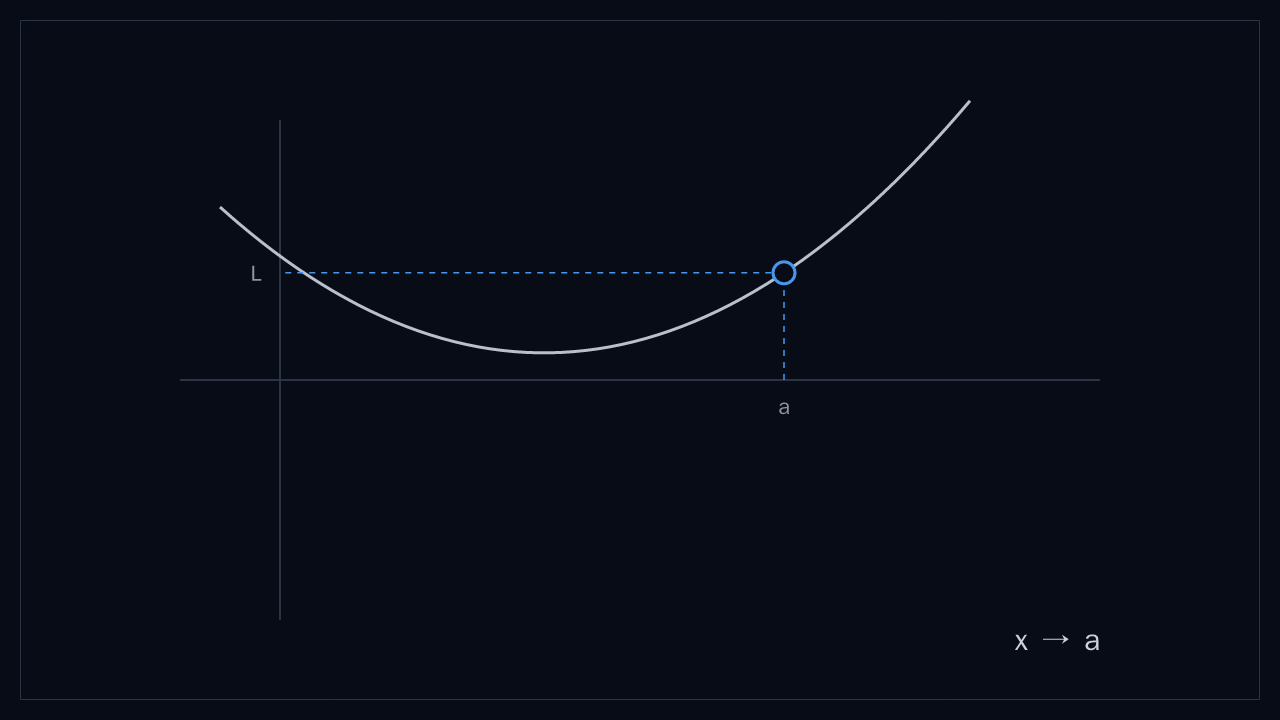
Substituting a value and getting 0/0 is the start of a limit question, not its answer. You need to find what the expression approaches near that value, sometimes after removing a factor or rewriting a radical.
Limits become easier when you distinguish the value of a function from the value it approaches. That distinction also explains why a piecewise function can have a limit and still fail to be continuous.
Choose the method before calculating
Try direct substitution first. If it gives an indeterminate form, choose a change that addresses the expression: factor a polynomial, rationalise a radical or divide by the highest power for a limit at infinity.
For continuity, check the function value and both one-sided limits. All must agree at the point. A missing value can make a function discontinuous even when its left and right limits match.
Formula reference
These relationships need the conditions stated in the question. Check units, signs and any restrictions before substituting values.
lim x->a  (x^n - a^n)/(x - a)   = n a^(n-1)
lim x->0  sin x / x             = 1
lim x->0  tan x / x             = 1
lim x->0  (1 - cos x)/x^2       = 1/2
lim x->0  (a^x - 1)/x           = ln a
lim x->0  (e^x - 1)/x           = 1
lim x->0  (1 + x)^(1/x)         = e
lim x->inf (1 + 1/x)^x          = e
lim x->inf (1 + a/x)^(bx)       = e^(ab)
Rational functions as x goes to infinity, comparing the degree of the top (p) with the bottom (q):
p < q   limit = 0
p = q   limit = ratio of leading coefficients
p > q   limit is infinite
Continuity at x = a needs three things to hold together:
f(a) is defined
left-hand limit = right-hand limit
that common limit = f(a)
Worked examples
Try each question before reading its solution. These are preparation examples, not official NET questions.
1. Find lim x->0 (sqrt(49 + x) - 7)/x.
Substitution gives 0/0. Rationalise by multiplying top and bottom by sqrt(49 + x) + 7:
(49 + x - 49) / [x (sqrt(49 + x) + 7)] = 1 / (sqrt(49 + x) + 7) -> 1/14
2. Find lim θ->0 (1 - cos pθ)/(1 - cos qθ).
Use 1 - cos t behaving like t^2/2 near zero:
(p^2 θ^2 / 2) / (q^2 θ^2 / 2) = p^2 / q^2
3. Find lim x->infinity (x/(1 + x))^x.
This is a 1^infinity form. Flip the fraction:
(x/(1 + x))^x = 1 / (1 + 1/x)^x -> 1/e
4. Find lim x->0 (25^x - 2(5^x) + 1)/x^2.
The top is a perfect square: 25^x - 2(5^x) + 1 = (5^x - 1)^2. So
[(5^x - 1)/x]^2 -> (ln 5)^2
5. For which k is f continuous at x = 2, if f(x) = kx + 1 for x up to 2 and f(x) = 3x - 1 for x above 2?
The left limit and f(2) are both 2k + 1. The right limit is 3(2) - 1 = 5. Set them equal: 2k + 1 = 5, so k = 2.
Turn the examples into practice
Practise identifying the method before doing the working. Keep separate examples of a removable hole, a jump and an infinite limit, so the word "undefined" does not become your answer to every case.
Use limit practice and review functions if domains are the issue. Move to differentiation once the distinction between a value and a limit is clear.
Sources and scope
- Use the official subject weightings to check whether this subject belongs to your NET category.
- NUST does not publish a guaranteed chapter question count. These examples are for learning methods, not predicting a paper.
Source: HSSC textbook topics and SailToNUST practice material; NUST subject weightings reviewed October 2026
FAQ
Can I use L'Hôpital's rule in NET?
0/0 or infinity/infinity form, and it is often faster than factorising.What is the limit of sin x over x in degrees?
pi/180, about 0.0175. The result 1 holds only when x is in radians.